
The Australian AI Jobs Story May Be Different to What We Expected

New research finds that firms adopting AI are more likely to be hiring
For the past two years, the dominant narrative around artificial intelligence and work has been relatively straightforward: AI will automate jobs, reduce headcount and replace large sections of the workforce. There has certainly been evidence pointing in that direction. But new Australian research suggests the reality may be more complicated.
In April, CSIRO released labour market research analysing hiring patterns across more than 4,000 Australian firms between 2020 and 2023. Published in the Australian Journal of Labour Economics, the study compared firms that had adopted AI with those that had not. It is not definitive on every question about the impact on what AI will do to jobs, but it is the most rigorous, Australia-specific employment data on AI adoption yet published, and its findings deserve careful attention.
The headline finding: Australian firms that adopted AI posted 36% more non-AI job advertisements over time than comparable firms that did not.
The research found that AI-adopting firms were advertising for roles with broader skill requirements and faster hiring timelines. Demand for AI-exposed workers, including accountants, analysts, lawyers and similar knowledge workers, held steady or increased at adopting firms. At non-adopting firms, demand for these same roles declined slightly.
As CSIRO's Dr Claire Mason put it: "AI-exposed workers may be disadvantaged if they're in firms that aren't using AI. Their peers in AI-adopting firms are potentially more competitive because they're able to use these tools to augment their work."
This distinction has direct implications for how associations frame AI to their members. The question is not "will AI take my job?" It is "is my organisation on the right side of this capability divide, and is my profession giving me the tools to function inside an AI-adopting workplace?"
The CSIRO research also found that AI-related skills are appearing in job advertisements for roles where they were not historically expected: sales, security and architecture among them. This indicates a baseline shift in workforce expectations. Jobs and Skills Australia's Generative AI Capacity Study, published in 2025, reinforces this point. It found that generative AI is more likely to augment than replace work in Australia, but with adoption uneven across industries.
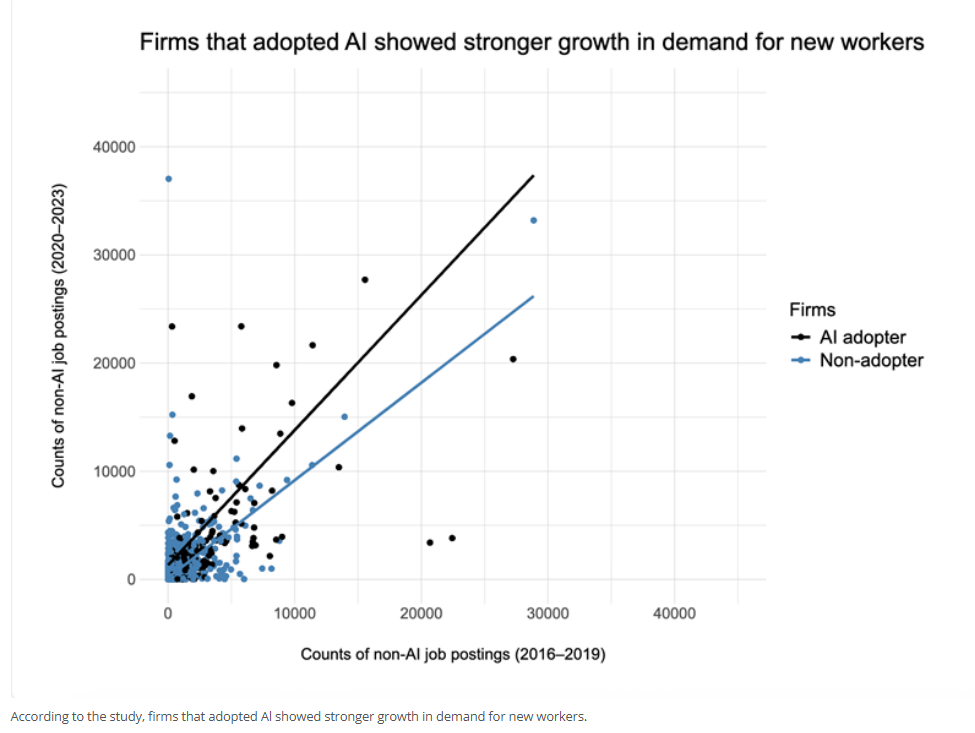
Source: CSIRO AI adopters aren’t cutting jobs, they’re creating them, April 2026
AI capability is becoming base level workforce expectation.
That finding aligns with broader, emerging labour market trends. Indeed’s Hiring Lab recently reported that Australian job advertisements referencing generative AI more than doubled year-on-year, with AI capability increasingly appearing outside traditional technology roles. Demand for AI-related skills is now spreading into occupations such as sales, customer service, project management and professional advisory work.
Importantly, the occupations most exposed to generative AI are often professional and knowledge-based roles built around communication, analysis and administration - the professions associations represent. Yet exposure does not automatically translate into job loss. Instead, many organisations appear to be restructuring work around AI, using it to automate parts of jobs while increasing the value of human capabilities such as judgement, interpretation and decision-making.
What makes the CSIRO findings particularly important is that they are based on actual Australian firm behaviour rather than theoretical modelling. And they point towards a different workforce challenge than many organisations may have been preparing for. The issue may not be job loss. It may be capability transition.
As AI is integrated into everyday workflows, employers increasingly need workers who can operate alongside these systems, interpret outputs, apply judgement and adapt to changing processes. While historically organisations separated “technology roles” from “business roles”, AI increasingly blurs that distinction. The ability to work effectively with AI is becoming embedded inside mainstream professional capability rather than sitting alongside it.
For associations, the biggest risk for your industry may not be job losses, but an insufficient supply of workers equipped to operate effectively in AI-enabled workplaces. It might also be members working for firms that are yet to adopt AI failing to build AI skills and capability and falling behind.
As workforce expectations shift, associations and industry bodies will need better evidence about how roles, skills and capability requirements are changing across their profession.
Overall, it is important to recognise that national-level research tells you the overall direction; it cannot tell you want AI means for an individual member in a specific profession. Associations occupy that gap. They know the workflows, regulatory environments and career anxieties of their members in ways no economy-wide study can replicate.
The Governance Institute of Australia is right that the biggest risk on AI is doing nothing, and the CSIRO data makes clear that inaction is not a neutral position. If your association is ready to develop a more grounded approach, the most useful starting point is member research: what AI tools are members already using, what do they understand about AI's effects on their profession, and what would they most value in response?
At Survey Matters, our workforce census, workforce capability and AI readiness studies help associations understand emerging workforce trends, skills shortages, professional pressures and the impact of industry transformation, including AI adoption. By combining workforce data, member insight and labour market analysis, we help associations build evidence-based strategies for workforce planning, professional development and future capability needs.
To discuss a workforce census or AI capability study for your profession, contact us via info@surveymatters.com.au