
PWC Global Survey reveals Australian CEOs are cutting jobs – and associations have a critical role to play
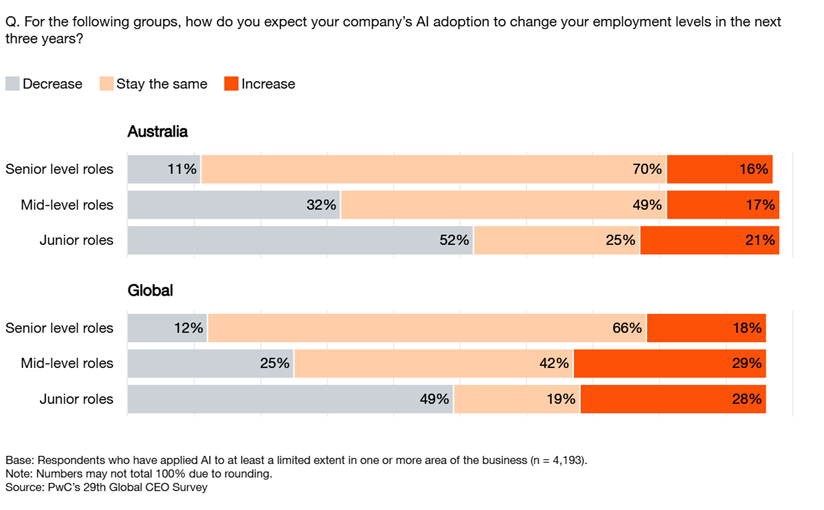
The newly released PwC Global CEO Survey has a clear message for Australian associations. While local CEOs are more confident about revenue growth than their global peers, they are also planning deeper job cuts, particularly in junior and mid-career roles, as artificial intelligence reshapes work faster than expected. Only 14% of Australian CEOs report that AI adoption has delivered additional profit so far, well below the global average, yet at the same time, more than half expect junior roles to shrink over the next three years, and nearly one-third anticipate cuts to mid-career positions. This is occurring even as 68% of CEOs say upskilling is their top priority.
The message is not that AI is failing. It is that many organisations are struggling to turn AI investment into productivity because workforce readiness is lagging technology adoption.
The risk is not automation alone, but unprepared workforces
The PwC findings reflect a growing pattern seen across global research. AI is not wholesale replacing professional jobs, but it is rapidly changing tasks within roles. When organisations lack visibility over how AI is already being used, either formally or informally, they default to blunt responses: hiring freezes, reduced graduate intake, or role cuts aimed at forcing efficiency.
This approach carries real risk. Cutting roles before building capability reduces the institutional knowledge needed to guide AI use responsibly and effectively. It also undermines the very productivity gains CEOs are seeking.
What is missing is a clear, evidence-based understanding of readiness in each industry: who is already using AI, how confidently, for which tasks, and with what governance in place.
The National AI Plan makes the case for association leadership
The Australian Government’s National AI Plan, (December 2025) highlights this critical gap: AI’s benefits will only be realised through “deliberate and coordinated action” focused on skills, workforce transition and responsible use.
Importantly, the Plan places professional and industry bodies at the centre of this effort. It recognises that AI will reshape tasks more than eliminate jobs, which makes reskilling, role adaptation and shared standards essential.
The Plan also calls for stronger sector level measurement of capability, adoption and responsible practice - evidence associations are uniquely positioned to generate.
Government agencies expect to partner with associations to build responsible AI skills across membership networks Associations with strong, sector-level data on AI readiness will be better placed to shape policy, attract funding and establish their value as credible partners.
In this way, the National AI Plan creates both an expectation and an opportunity for associations to lead and shape how their profession adapts.
Why measuring readiness must come first
Research shows that many organisations confuse experimentation with readiness. Early pilots or access to tools can appear to be progress even when capability, workflows and governance remain inconsistent.
Associations can address this gap. While individual employers see only their own workforce, associations see capability across an entire profession- provided they have the right measurement tools.
The Survey Matters AI Skills Readiness Index provides this visibility. Instead of asking whether AI is being used, it measures how prepared people are to apply AI safely and effectively in the tasks that matter. It assesses foundational literacy, applied capability, confidence and understanding of risk.
The Index helps associations build an evidence base, identify shared gaps, guide professional development and support members to adapt.
The Survey Matters AI Skills Readiness Index will allow associations to:
establish an evidence base before workforce disruption accelerates
identify shared skills gaps that require collective solutions
inform professional development, credentialing and standards
support members to adapt, rather than be displaced
Associations that act now, with data, will be best placed to protect professional standards, support members, and help ensure AI delivers productivity gains without unnecessary job loss.